Species: Bald Eagle (Haliaeetus leucocephalus)
Family: Accipitridae
Date: 8.5.15
Observation:
This Bald Eagle was not spotted right outside our home, but we decided to include a few things we saw over our summer vacation. This eagle was spotted on Haskell Island in Maine during our August trip to the island.
A Fact from Alice:
The largest observed Bald Eagle nest (St. Petersburg, Florida) was nearly 3 meters in diameter and over 6 meters tall.
Learn more at All About Birds - Bald Eagle
Species: Red Admiral (Venessa atalanta)
 Family: Nymphalidae
Date: 7.22.15
Family: Nymphalidae
Date: 7.22.15
Observation:
I wasn't planning on taking any pictures this day, but I changed my mind when this Red Admiral decided to hang around the asters in our backyard.
Facts:
Red Admiral butterflies prefer to feed on sap slows and fermenting fruit; nectaring on flowers is typically a secondary option. Caterpillar hosts are the nettle family.
Learn more at Butterflies and Moths of North America - Red Admiral
Species: Atlantis Great Spangled Fritillary (Speyeria cybele)
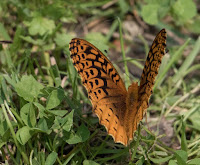 Family: Nymphalidae
Date: 7.5.15
Family: Nymphalidae
Date: 7.5.15
Observation:
This post is a little after the fact. The Atlantis Great Spangled Fritillary was spotted by one of the girls during the Fourth of July celebration (on the 5th) at Gumma and Gogo's. We didn't get around to trying to identify the fritillary until this morning.
A Fact:
The caterpillar hosts are violets and the butterflies are generally in flight from the second week in June through the last week of September in Vermont.
Learn more at Butterflies and Moths of North America - Great Spangled Fritillary
Species: Common Yellowthroat Warbler (Geothlypis thricas)
Family: Parulidae
Date: 7.13.15
Observation:
These photos were take on two different days at two different locations. The male yellowthroat (top picture) was photographed down by the Muddy Branch. The female (middle photo) and juvenile (bottom photo) were in the underbrush on the edge of the back lawn. I believe there were two different juveniles with the female, probably around two weeks old (give or take a week).
A Fact:
Common Yellowthroats are one of the bird that are particularly susceptible to brood parasitism (brown-headed cowbird lay eggs in their nest). The song of the male Common Yellowthroat is one of the more recognizable and common summer bird songs...I will add audio at some point.
Learn more at All About Birds - Common Yellowthroat Warbler
Species: Eastern Chipmunk (Tamias striatus)
Family:
Date: 7.15.15
Observation:
This is one of the chipmunks I get to see everyday. They are certainly not one of my favorite critters, but up close they are kind of cute. Still a nuisance overall.
A Fact:
Chipmunks are most active during mid-morning and mid-afternoon. They are very territorial and primarily stay within a range of 15 to 25 meters from their burrow.
Learn more at Animal Diversity Web - Eastern Chipmunk
Species: Tiger Crane Fly (some member of the genus Nemphrotoma)
Family: Tipulidae
Date: 7.13.15
Observation:
I photographed this Crane Fly while I was walking around the yard a coupled of days ago. Alice and I were able narrow it down to being a Crane Fly. My best guess is that it is a type of Tiger Crane fly.
A Fact or two:
Crane flies occur worldwide, and there are more than 15,000 different species and subspecies. Most species inhabit a fairly small geographical range. These flies are sometimes referred to as "daddy long legs."
Learn more (I hate to do it, but there aren't many good options here) at Wikipedia - Crane Flies
Species: Red-eyed Vireo (Vireo olivaceous)
Family: Vireonidae
Date: 7.13.15
Observation:
Getting a photograph of a Red-eyed Vireo seems remarkably challenging given the fact that they can be heard singing throughout the day. The male here was pausing to sing as it foraged in the top of one of the large tree on the north end of the lawn. In the background you can hear a Black-capped Chickadee and one of the many annoying mosquitoes. (I apologize - the mosquito sound is very distracting)
A Fact:
The male Red-eyed Vireo sometimes sings more than 20,000 times in one day. It is a song worth learning, because you will hear it all the time, even in the middle of the day when most birds are not singing.
Learn more at All About Birds - Red-eyed Vireo
Species: Common Grackle (Quiscalas quiscula)
Family: Icteridae
Date: 7.8.15
Observation:
This Common Grackle was hanging around with the Red-winged Blackbirds down by the Muddy Branch. The accompanying photos show the grackle with its eyes open and closed - always a little eerie.
A Fact:
Grackles are the number one (bird) threat to corn; they eat both ripening corn and corn sprouts.
Learn more at All About Birds - Common Grackle
Species: Cedar Waxwing (Bombycilla cedrorum)
Family: Bombycillide - Waxwings
Date: 7.9.15
Observation:
Cedar Waxwings are some of the more noticeable birds on our property - typically flying around in pairs or threes. These photographs are from down by the Muddy Branch on the north end of the property. It was later in the evening and the waxwings weren't as quick to move on as they often are earlier in the day.
A Fact:
In the northeast, you may find a Cedar Waxwing with tail-tips that are more orange than yellow. This is a result of the red pigment from the berries of an introduced species of honeysuckle. The orange tail-tips were first noticed in the 1960's.
Learn more at All About Birds - Cedar Waxwing
Species: Red-winged Blackbird - female (Agelaius phoeniceus)
Family: Icteridae
Date: 7.9.15
 Observation:
I went down to the Muddy Branch at the north end of our property last night and was greeted by the alarm call of many blackbirds who did not appreciate my presence. The female with the grasshopper (I think) in her mouth kept a very close eye on me. After a few minutes things quieted down as the birds became a little more relaxed, as long as I didn't move around much.
 A Few Facts:
Red-winged Blackbirds are highly polygynous - some males may have up to 15 females mates. Not surprisingly, males spend a great deal of their time defending their territory (roughly a quarter of the daylight hours). Studies have shown that typically one-quarter to one-half of the nestlings are sired by someone other than the territorial male.
Learn more at All About Birds - Red-winged Blackbird


