Species: Common Grackle (Quiscalas quiscula)
Family: Icteridae
Date: 7.8.15
Observation:
This Common Grackle was hanging around with the Red-winged Blackbirds down by the Muddy Branch. The accompanying photos show the grackle with its eyes open and closed - always a little eerie.
A Fact:
Grackles are the number one (bird) threat to corn; they eat both ripening corn and corn sprouts.
Learn more at All About Birds - Common Grackle
Species: Cedar Waxwing (Bombycilla cedrorum)
Family: Bombycillide - Waxwings
Date: 7.9.15
Observation:
Cedar Waxwings are some of the more noticeable birds on our property - typically flying around in pairs or threes. These photographs are from down by the Muddy Branch on the north end of the property. It was later in the evening and the waxwings weren't as quick to move on as they often are earlier in the day.
A Fact:
In the northeast, you may find a Cedar Waxwing with tail-tips that are more orange than yellow. This is a result of the red pigment from the berries of an introduced species of honeysuckle. The orange tail-tips were first noticed in the 1960's.
Learn more at All About Birds - Cedar Waxwing
Species: Red-winged Blackbird - female (Agelaius phoeniceus)
Family: Icteridae
Date: 7.9.15
 Observation:
I went down to the Muddy Branch at the north end of our property last night and was greeted by the alarm call of many blackbirds who did not appreciate my presence. The female with the grasshopper (I think) in her mouth kept a very close eye on me. After a few minutes things quieted down as the birds became a little more relaxed, as long as I didn't move around much.
 A Few Facts:
Red-winged Blackbirds are highly polygynous - some males may have up to 15 females mates. Not surprisingly, males spend a great deal of their time defending their territory (roughly a quarter of the daylight hours). Studies have shown that typically one-quarter to one-half of the nestlings are sired by someone other than the territorial male.
Learn more at All About Birds - Red-winged Blackbird
Species: American Redstart - First summer male
Family: Parulidae
Date: 7.6.15
Observation:
The first photograph captures the view that had me very interested and perplexed. I really didn't know what I was looking at. The second image is what pointed me in the direction of an American Redstart, but the plumage was very interesting. After consulting a couple of sources, it seems (at least to me...I would be very happy to be corrected) that this is a first summer male that had not developed the adult plumage. The bird in the third photo, I believe, is another first summer male, although it could be the same individual in different lighting that I captured on my walk back down the edge of the meadow. In both instances, the birds were foraging in the growth along the meadow about ten feet off the ground.

A Fact:
Male American Redstarts may have two mates at the same time. While polygamy is not uncommon in birds, the redstart is different in that the male often holds two different territories that may be separated by a quarter-mile.
Species: Baltimore Oriole (Icterus galbula)
Family: Icteridae
Date: 7.6.15
Observation:
I spotted this Baltimore Oriole making a couple trips to the end of a branch high up in a pine on the edge of the meadow. The oriole was bringing food for a fledgling that was resting in the tree.
A Fact from Annie:
The Baltimore Oriole and Bullock's Oriole were considered one species until the 1990's when genetic tests showed they were two distinct species. The two hybridize extensively in the Great Plains region where the range of the two species overlap.
Learn more at All About Birds - Baltimore Oriole
Species: Appalachian Brown (Satyrodes appalachia)
Family: Nymphalidae
Date: 7.6.15
 Observation:
I spotted and photographed this Appalachian Brown on the path over the new waterline that runs through the back of our property. The family spent a good deal of time trying to determine whether this was an Appalachian Brown or an Eyed Brown (Eyed Browns are a bit more common), but we feel it is an Appalachian Brown. This is the second time we have identified a butterfly that is listed as being "very rare" in Vermont - the first was the Silvery Checkerspot. That has me a little concerned about our identification abilities.
A Fact from Kate:
The Appalachian Brown's habitat is wooded wet swamps, shrub swamps, forest edges and along slow moving streams.
Learn more at Butterflies and Moths of North America - Appalachian Brown
Species: Six-spotted Green Tiger Beetle (Cicindela sexguttata)
Family: Cicindelidae - Tiger Beetles
Date: 7.03.15
Observation:
This unfortunate tiger beetle was stuck in our kiddie pool, but was liberated shortly after the photo was taken when the pool was emptied. Alice took charge of identifying the beetle with the help of Michelle.
A Fact from Michelle:
Females place eggs singly in holes along paths in the woods and adults emerge in summer.
Learn more at Nature's Notebook - Six-spotted Tiger Beetle
Species: Eastern Wood-Pewee (Contopus virens)
Family: Tyrannidae
Date: 6.24.15 (Updated photos on 7.2.15)
Observation:
Alice spotted the Eastern Wood-Pewee as it landed on a branch of our back-yard brush pile. As I slowly attempted to get closer, we saw the bird sallying out (the feeding technique of looping out, catching an insect, and returning to the same or nearby perch) to catch insects five or six times in a minute.
A Fact from Alice:
Eastern Wood-Pewees are usually found in forest clearings (like our back-yard). They are often spotted on dead branches, as they like to sit on conspicuous perches when they are foraging for insects.
A Fact from Dana:
Eastern Wood-Pewees are territorial during breading season. A male's territory is often 5-20 acres, and a male pewee will attack other species that approach while he is singing.
Learn more at All About Birds - Eastern Wood-Pewee
Species: Honey Bee (Apis mellifera)
Family: The Apids (Apidae)
Date: 7.01.15

Observation:
Alice is home with me on this rainy Wednesday, and she decided we should look at pictures and find something to add to our blog. She has chosen the Honey Bee. The bees pictured here are on milkweed flowers.
A Few Facts from Alice:
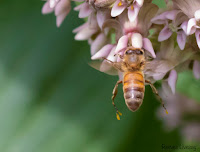
Queen bees have an average lifespan of one to three years, and they can lay over 1500 eggs in one day. Worker bees are not only responsible for gathering nectar and making honey, but also for maintaining the temperature (93 degrees Fahrenheit) of the nursery. If the weather is hot they use their wings to collectively fan the nursery. If the weather is cool, they cluster around the nursery to generate heat. Drone bees serve one function for the colony: they mate with the new queens. Once a drone mates with a new queen, it immediately dies.
Learn more at Everything About - Honey Bee
Species: Gray Tree Frog (Hyla versicolor)
Date: 6.30.15
Observation:
I was wrapping up some work on the soon-to-be turn around off our driveway and was in the process of flipping Ken's wheelbarrow over since it looked like it was going to rain when I spotted this frog on the handle of the wheelbarrow. It was quite camouflaged...it may have been there the entire time I was working. After looking at this frog, I wanted to go take a nap!
A Fact from Annie:
The Gray Tree Frog is one of the loudest frogs that have been measured in North America.
Learn more at Rhode Island Vernal Pools - Gray Tree Frog


